
Field Notes · AI & the Future of Design
Designing the Future: Ravi Sawhney on AI & Data Driven Leadership
Listen to the episode, then read the key ideas from the conversation.
AI & Data Driven Leadership
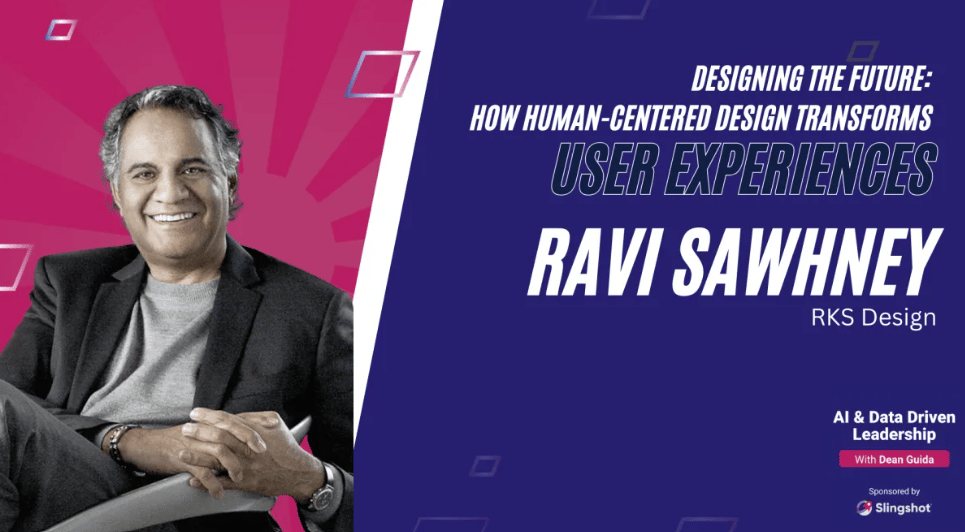
Designing the Future: How Human-Centered Design Transforms User Experiences
RKS Design founder and CEO Ravi Sawhney joined Dean Guida on the AI & Data Driven Leadership podcast to talk about how AI is changing human-centered design, and where it falls short. Dean, who builds software tools, wanted to know how a physical product firm uses AI day to day. Here are the main ideas from the conversation.
A toolkit for getting people to say yes
Ravi's work began at Xerox, beside psychologists building the first touchscreen interface. The lesson: everything is about human factors, and the hardest challenge is getting people to adopt something new for themselves. In 1982 he wrote the principle that still guides RKS: it's not how you feel about a design or experience, it's how it makes you feel about yourself.
That grew into Psycho-Aesthetics®, a toolkit of personas, user journeys, "help me" statements and competitive benchmarking, all brought together on a map of interactivity against self-actualization. Layered on top is Joseph Campbell's hero's journey: attract people, engage them, lead them to adoption, then give them a moment of truth that makes them feel good about themselves and want to tell others. Ravi's favorite proof is still a Zyliss can opener with tens of thousands of positive reviews.
Everyone is on a hero's journey
Dean knew the hero's journey from movies. Ravi sees it in everyday life: we're all on one, every day, looking for affirmation. He pointed to Teddy Ruxpin in the 1980s. A parent searches store to store, finally finds the sold-out bear, and on Christmas morning watches their child light up and hug them a little tighter. "We all want to be heroes to our kids," Ravi said, and to our teammates and ourselves.
Three to five reasons to care
RKS scripts those moments. The team breaks down what will attract and engage people, checks it against personas, and distills it into a handful of distinct, valuable propositions.
"If it's less than three, it's underwhelming. If it's more than five, you tend to forget the first one."
Overload people and they feel like they don't get it, and you lose them. And "natural" isn't the finish line. The goal, Ravi said, is empowerment: the feeling that you're doing something good for yourself or for others.
AI fuels the research, not the creativity
RKS uses AI to feed the Psycho-Aesthetics process: research, insight and writing. It doesn't use AI for the creative work. AI is based on everything that came before, Ravi said, so it can't forecast what people will want two, three or ten years from now. It also can't sense the nuance of what feels right to someone, and anything you ask it to design ends up in the public domain, which puts a client's intellectual property at risk.
AI has made the team more efficient, but it hasn't replaced fieldwork. RKS still talks to surgeons, nurses and staff in hospitals and shows them hypotheticals. In homes around the world, studying how people hand-wash laundry for Unilever, the team found something no dataset would reveal: sending children to school in clean, ironed clothes was a reflection of how much their parents loved them. That's why our ethnographic research still starts with people, and why it matters so much in packaged goods.
Visuals as a common language
Psycho-Aesthetics is a visual language. Turning research and AI output into personas, maps and journeys gives finance leaders, CEOs and marketers a shared picture, instead of design jargon that leaves them feeling shut out. Visuals also help recall: months of healthcare research are hard to remember as words, but easy to bring back with the right images. Ravi has made the templates available in Psycho-Aesthetics 2.0, because if everyone is more successful, that's good for everyone.
Designing for health and safety
Ravi shared two recent projects. One, a five-year effort, reimagined hookah for its roughly 100 million users: instead of burning charcoal that releases carbon monoxide and heavy metals, a patented electronic system uses sealed pods, and a connected app can lock out children. The other is a new way to dispense medication: a proprietary capsule in a biometric device with a thumbprint reader and an app that reminds patients, and lets families or physicians monitor adherence. Ravi noted that non-adherence costs about 150,000 American lives every year. Both are examples of how our medical device design and IoT product design work combine hardware, software and human insight.
The guitars in the background
Dean asked about the guitars behind Ravi. About 20 years ago, Ravi started learning guitar and asked: why not reinvent it? RKS mapped the market with a hundred guitars on stands and created a sustainable electric guitar at a time when the industry relied on rainforest tonewoods. With his friend and partner, the late Dave Mason of Traffic, the team refined the guitars on stage. Ravi recalls RKS built a factory and produced about 2,000 RKS Guitars, played by artists including Keith Richards and the Eagles' Don Felder.
Resources mentioned
- Psycho-Aesthetics® methodology at RKS Design
- Psycho-Aesthetics 2.0 by Ravi Sawhney (on Amazon), with open templates
- Case studies: Teddy Ruxpin, Zyliss, RKS Guitars
Want AI to sharpen your understanding of customers, not replace it? Our UI/UX design, industrial design and product development teams start with people. See the markets we serve or start a conversation.
This episode originally aired on AI & Data Driven Leadership, hosted by Dean Guida. Thank you to Dean for the conversation.