
Field Notes · Psycho-Aesthetics & HCD
Understanding Consumer Needs: Ravi Sawhney on Bridging Success
Listen to the episode, then read the key ideas from the conversation.
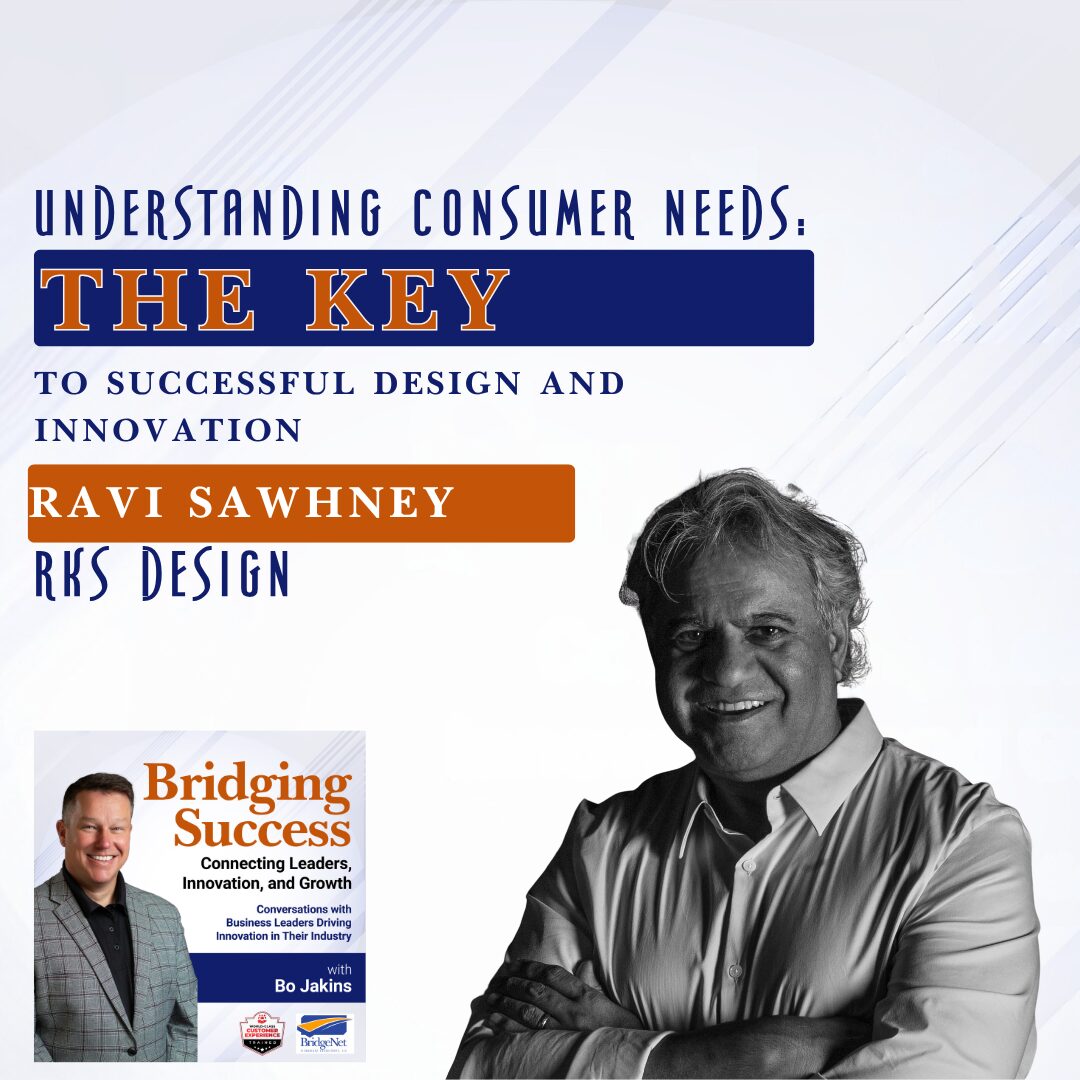
Bridging Success
Understanding Consumer Needs: The Key to Successful Design and Innovation
RKS Design founder and CEO Ravi Sawhney joined Bo Jakins on Bridging Success, a podcast for B2B leaders, to talk about what it really takes to understand consumers. He shared the inside story of Teddy Ruxpin, how to start using Psycho-Aesthetics®, and why a locking handle on a can opener says so much about design. Here are the main ideas from the conversation.
Teddy Ruxpin, from the inside
RKS was approached by Alchemy II, an animatronics company that had built a prototype bear around a cassette player: one audio channel moved the eyes and mouth, the other carried the voice. Teddy was already a beloved character, with years of tested stories from his creator, Ken Forsse. The job was to make the bear manufacturable and ready for market. Three design groups started; the pace was so intense that the other two dropped out, and Ravi's team ended up designing the head, the animatronics, the body and the parts inside.
Two observations shaped the product. First, it had to look like a soft, cuddly teddy bear, not a machine. Second, small children would never manage the two-step stop-and-eject buttons on cassette players of the day. Ravi designed a door with molded cams: lift it, and it pressed stop, then eject, and raised the tape. Even a three-year-old could change a story. Add a store display where Teddy opened his eyes and said hello as shoppers walked by, and Teddy Ruxpin became a phenomenon in 1985. Ravi recalls months of 16-hour days, seven days a week, to get there.
Choosing more than toys
Teddy brought RKS huge credibility, and toy companies came calling. Financially, Ravi admits, staying in animatronic toys may have been the easier path. But he had come out of Xerox, where he worked with about 30 psychologists on the first touchscreen interface, and his ambitions were broader. His heart, he said, has always been in making people happy and improving their quality of life. That is what has driven RKS ever since.
Psycho-Aesthetics in first gear
Ravi calls Psycho-Aesthetics his legacy: a full human-centered design methodology anyone can pick up. RKS drives it in fifth or sixth gear, he said, while a beginner might start in first. It is used for branding, business innovation and product development, and it lowers the risk of bringing anything new to market.
First gear is the map. Plot competing products by interactivity and self-actualization: a paperclip at the low end, an excavator that is complex but just a tool, the Mona Lisa you never touch but always remember, and a sports car that is high on both. The team debates where each product belongs. Ravi says that alone is a powerful team-building exercise. He has seen countless meetings end with everyone in agreement, each agreeing to something different. "When you visualize it, everybody syncs up," and because it's visual, the map bridges languages and disciplines.
Finding the opportunity zone
The next level maps personas. For Life Technologies, RKS mapped chief scientists, executives and technicians. The team expected buyers to care mainly about speed. Instead, they saw their work as improving life on the planet and wanted equipment that felt like a trophy of scientific success. That moved the target to the upper right, into an open opportunity zone. Ravi recalls that within two hours RKS showed the company's leaders the map, the personas and design language options, and that the new global design language was part of a run from about a $5 billion market cap to roughly a $15 billion exit. It is a good example of how life sciences product design is about people as much as performance.
A locking handle
Ravi's simplest example is a can opener for Zyliss. After watching people open cans and doing it themselves, the team noticed a common frustration: get distracted, loosen your grip on the handles, and you're left with a half-opened can. Ravi proposed latching the handles together once the can is pierced, so you can just turn the knob without thinking. Ravi recalls the opener now has close to 40,000 Amazon reviews. "Sometimes you don't have to do a lot to make people's lives better," he said. It is the kind of insight behind our consumer product design.
The voice of the consumer on steroids
Bo asked how RKS stays ahead. Ravi pointed out that the RKS portfolio has no house style, because the firm is "the voice of the consumer on steroids." The team does deep ethnographic research, technology scouting and trend analysis, and sometimes invents the technology to meet needs people haven't articulated.
"If you ask people what they want, they can only tell you what they know."
Henry Ford's customers would have asked for faster horses. Ravi's approach is to keep asking why. Why do you need a faster horse? What's wrong with the one you have? That's how you find something people would love that doesn't exist yet.
What's on the bench
At any time RKS has about a dozen projects underway. Ravi described a studio where one team works on a next-generation DNA sequencer while the next designs the world's best dog bed, and another refines the four-headed Quatro toothbrush. RKS also incubates companies using Psycho-Aesthetics, including Finnita, a student debt reduction venture that grew out of a Psycho-Aesthetics exercise and is now heading toward an AI solution.
On AI in toys, Ravi was thoughtful. Teddy Ruxpin worked because it was passive until you brought it to life, and people love to humanize things, like the dog who seems to talk. But AI isn't for everything everywhere. Do you really want your doorknob to welcome you home?
Resources mentioned
- Psycho-Aesthetics® methodology at RKS Design
- Psycho-Aesthetics 2.0 by Ravi Sawhney (Amazon, Kindle and print)
- Case studies: Teddy Ruxpin, Life Technologies, Zyliss, Quatro, Finnita
Want to understand what your customers would love before they can say it? Our industrial design and product development teams start there. See the markets we serve or start a conversation.
This episode originally aired on Bridging Success, hosted by Bo Jakins. Thank you to Bo for the conversation.