
Field Notes · Psycho-Aesthetics & HCD
Psycho-Aesthetics Experiences: Ravi Sawhney on Experience by Design
Listen to the episode, then read the key ideas from the conversation.
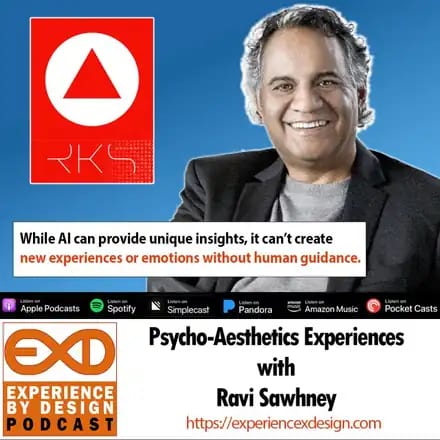
Experience by Design
Psycho-Aesthetics Experiences with Ravi Sawhney
RKS Design founder and CEO Ravi Sawhney joined sociologist Gary David of Bentley University on Experience by Design for a wide-ranging hour on art, aesthetics and human-centered design. They covered his path from ceramics student to Xerox PARC, how to help people accept new ideas, the story of RKS Guitars, and why AI needs a human layer. Here are the main ideas from the conversation.
From ceramics to Xerox PARC
Ravi was a three-dimensional artist from the start: taking alarm clocks apart as a child and taking six ceramics classes in high school. He enrolled in mechanical engineering because he thought engineers decided how things look and work. The dean of engineering corrected him: that's industrial design, and it lives in the art department.
He worked as a model maker at 19, was designing by his senior year, and at 22 joined Xerox, where his boss Frank Zinni sent him into a think tank of PhD psychologists and about 200 programmers building one of the first touchscreen interfaces. Ravi created its graphical interface, an early example of what we now call UI/UX design, and left with the lesson that still drives RKS: it's all human factors. It's about people, not the artifact.
Helping people say yes to new ideas
Gary asked how to get organizations to embrace disruption when, in practice, most people resist it. Ravi's answer draws on Joseph Campbell's hero's journey. Design can attract people, but they will resist. The work is to move them past that resistance with a series of experiences that create anticipation, confirmation and affirmation, so that adopting something new makes them feel better about themselves.
He was candid about the corporate side: "You don't get fired for saying no." He recalled the CEO of SyQuest telling him his team had been offered the Zip drive and turned it down. The Zip drive took off, and SyQuest's business shrank to a fraction of what it had been. Understanding why people would choose a thinner, more portable product, before a competitor does, is exactly what innovation consulting is for.
Human-centered from day one
As "human-centered design" becomes a buzzword, Gary asked what it means at RKS. "It's not a service we provide," Ravi said. "It's just what we do." He wrote the firm's founding principle in 1982:
"It's not how you feel about a design or experience. It's how it makes you feel about yourself."
That idea became Psycho-Aesthetics®, the methodology behind 45 years of RKS work, a Harvard case study and a book from Wharton School Publishing. Ravi believes industrial design is especially well suited to lead here, because designers combine IQ, EQ and talent, and because people ultimately accept or reject what you make.
A guitar built for the player
RKS Guitars came out of Ravi's partnership with his longtime friend and collaborator, the late Dave Mason. Ravi says that without Dave's deep involvement it might have been just a novel-looking guitar. Instead, every decision focused on making the guitarist better: a sustainable design that doesn't rely on rare tonewoods, and controls and form that help a player do more than before.
Getting there took years of prototypes, testing at Dave's sound checks and fixing early versions that howled on stage. The test of success came at the NAMM shows. At first, musicians would play a few licks and hand it back. By the end, they wouldn't let go. Players paid to staff other booths spent their breaks at the RKS booth. As Ravi put it, there's no cookbook. The same thinking runs through our consumer product design, from guitars to Teddy Ruxpin.
AI needs a human intelligence layer
Ravi described PA-AI, the platform now called Eydora, as a human intelligence layer that directs AI through human-centered principles. AI can synthesize huge amounts of information, he said, and if you take five steps toward a door it can predict the next five. What it can't tell you is why you want to be on the other side of the door, or what you expect to feel when you get there.
The platform turns those human signals into a Success Potential Score, a 0 to 100 benchmark that helps leaders weigh more ideas, and reduce risk, before they commit capital. For Ravi, the central question is simple: do we serve technology, or does technology serve us? AI is a tool, and people should stay in charge of it.
Everyday objects carry identity
The conversation ended with everyday things. The travel mug at the center of the Harvard case study was once just a way to carry a drink. Today it signals identity, values and status. Ravi shared a test from his longtime collaborator, cognitive psychologist Bob Deutsch, for how people judge anything new: Is it like me? Does it like me? Can it make me more? Translating that into a real product, he said, takes talent and a lot of hard work.
Resources mentioned
- Psycho-Aesthetics® methodology at RKS Design
- RKS Guitars
- The story of Teddy Ruxpin
- Eydora (formerly PA-AI)
Have an idea people need to fall in love with? Our industrial design and product development teams start with what your customers will feel. See the markets we serve or start a conversation.
This episode originally aired on Experience by Design, hosted by Gary David. Thank you to Gary for the conversation.