
Field Notes · Psycho-Aesthetics & HCD
The Psychology of Design: Ravi Sawhney on Let's Talk About It
Listen to the episode, then read the key ideas from the conversation.
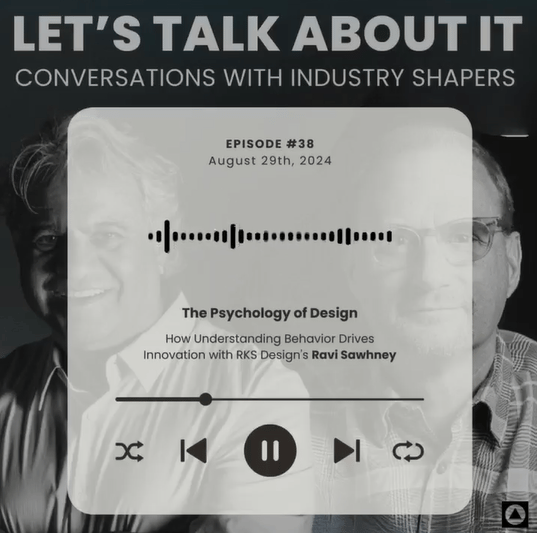
Let's Talk About It
The Psychology of Design: How Understanding Behavior Drives Innovation
RKS Design founder and CEO Ravi Sawhney joined Jeff Arnold on Let's Talk About It: Conversations with Industry Shapers to talk about nearly 50 years in industrial design, designing for a global market, and why the most meaningful products improve people's lives. Here are the main ideas from the conversation.
Just getting started
Ravi studied design at Cal State Northridge and ArtCenter, worked through college, and was hired by Xerox. He left to start a firm that would be human-centered from day one, something he had learned on the Xerox human factors and design team. Over the decades, RKS has moved from tactical to strategic work and now creates a great deal of intellectual property for clients. Ravi is named on more than 500 patents, and the team signs and assigns new utility patents to clients every couple of weeks. "I'm definitely not done," he said. "I'm just getting started."
Every client comes to us
RKS does no outreach; every client comes in. Some are among the largest companies in the world, like Samsung, or Intel, which came to RKS to apply Psycho-Aesthetics® to business innovation. Most arrive with a market they're in or want to enter and ask RKS to find the right answer to product-market fit: a solution that is profitable, beneficial and builds the brand. That's the heart of our innovation consulting and product development work.
RKS also incubates its own ventures. RKS Guitars made the cover of BusinessWeek and was played by Clapton, the Stones and the Who. Finnita, a student loan reduction company, was incubated and exited. And RKS is a partner in Quatro, a four-headed toothbrush that revives an older technology.
Designing for the world
RKS has clients in India, China, Korea, South America, Europe and the Middle East. "We're designing for the world market," Ravi said, and that means understanding people in context. You don't design an iPhone for rural Africa. You design a waterproof, drop-proof, energy-efficient phone that can get the weather, the radio, messaging and banking, and that lasts a week on a charge, because its owner may have to ride a bike for an hour to charge it.
"You have to love people to do great design."
Changing the drug adherence model
Asked what excites him most, Ravi named two projects. His favorite ever is the guitar, the first sustainable electric guitar, because music changed his world. But today it's a drug delivery system with Aspargo. Ravi noted that about 40 percent of people have trouble swallowing pills. The device delivers liquefied medication into the mouth, where about 80 percent is absorbed. A thumbprint reader keeps it child-safe, and alarms help people take time-critical medication on schedule. With about 150,000 people in the US dying each year from mismanaged medication, Ravi said, the goal is to change the drug adherence model completely.
He has always said he'd love to design the next Apple Watch. But helping someone live longer, or saving a life, means far more. That's why our medical device design work matters so much to the team. RKS has also reinvented the hookah as a pod system that eliminates burning coals and the carbon monoxide they produce.
The Apple effect
Why is the future bright? Not because of any one firm, Ravi said, but because people have changed. He calls it the Apple effect: people know design, can talk about it in detail, and won't accept less than great. Their expectations and aspirations drive what RKS does, and that's a good place for designers to be.
Psycho-Aesthetics 2.0
Ravi's goal for 2025 was to bring these products to market and get his new book, Psycho-Aesthetics 2.0, into mass readership, especially among educators and business schools. After working with Wharton School Publishing on Predictable Magic, he chose to self-publish so he could say exactly what he wanted. The ultimate challenge for a designer, he said, is to reinvent the design methodology itself. The book shows, through about a dozen case studies across fintech, business innovation, industrial design and branding, how to motivate people to do something for themselves they might otherwise not do.
The gift of a lifetime
Jeff asked for a hard-won lesson. Ravi went back to Xerox, where he was the youngest designer on a team of about 150 designers and 150 human factors specialists, and was assigned to a think tank developing a touchscreen with PhD psychologists. His first instinct was to say no. His boss, still a good friend, told him he was young and didn't know what he'd learn. Ravi went, and learned that technology is there for people and design is a tool to affect them. At the time, almost no one thought that way. "It was the gift of a lifetime."
Resources mentioned
- Psycho-Aesthetics® methodology at RKS Design
- Psycho-Aesthetics 2.0 by Ravi Sawhney (on Amazon Kindle)
- Case studies: Aspargo, RKS Guitars, Finnita, Quatro
Designing for people in markets you don't know yet? Our research and industrial design teams start by understanding them. See our consumer product design and other markets we serve, or start a conversation.
This episode originally aired on Let's Talk About It: Conversations with Industry Shapers, hosted by Jeff Arnold. Thank you to Jeff for the conversation.