
Field Notes · Design & Engineering Craft
The Award-Winning Strategy Behind Sustainable Product Design: Ravi Sawhney on Conscious Design
Listen to the episode, then read the key ideas from the conversation.
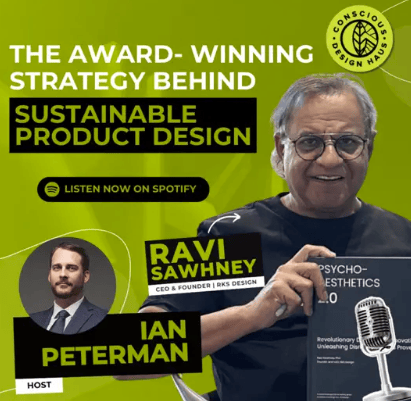
Conscious Design Podcast
The Award-Winning Strategy Behind Sustainable Product Design
Watch the conversation
RKS Design founder and CEO Ravi Sawhney joined host Ian Peterman on the Conscious Design Podcast, where sustainability meets innovation and business. They talked about design as a tool for people, how RKS reinvented the electric guitar to last for centuries, and why sustainability is now a given rather than a selling point. Here are the main ideas from the conversation.
Design is a human factors tool
Ravi started RKS in 1980 after Xerox, where working beside psychologists on the first touchscreen interface taught him that design is not a thing unto itself. It's a tool for affecting people's emotional state and quality of life. The goal is to change someone's life, not just to make an object of beauty.
That's harder than it sounds, because designers fall in love with their own work. Ravi compared it to a chef tasting their own food. His answer, developed over more than 30 years, is Psycho-Aesthetics®: a rigorous way to map personas, pain points and journeys so the team sees the work through the eyes of everyone who uses, specifies, approves and shares it. It rests on his 1982 principle: it's not how you feel about a design or experience, it's how it makes you feel about yourself.
Reassuring, not frightening
Nowhere does that matter more than in medicine. A patient may have no say in the technology, Ravi said, but when they see the device that will save their life, it should reassure them, not scare them. For a DNA vaccine delivery device, RKS hid the five needles behind a shield. The doctor presses it and the patient feels something like a single prick. Seeing five needles coming at you would make you tense your muscle, and a tense muscle makes the procedure far more painful. It's a small example of how medical device design shapes the experience of care. See the VGX vaccine delivery platform.
Designers make great researchers
Ian asked about design research, a topic the industrial design community wants more of. For Ravi, research is the foundation of the house. RKS designers run the research themselves: Ravi recalls well over 3,000 interviews worldwide, with one lead in Warsaw interviewing doctors with prototypes as they spoke. Designers notice nuance the way a comedian does. Did someone hesitate to touch the object? Did they glance around, embarrassed to be seen with it? That's the heart of our ethnographic research.
The Zyliss can opener shows the payoff. Letting the handles click together means you no longer need constant grip strength, which also helps people with arthritis or weaker hands. Ravi recalls about 44,000 positive Amazon reviews.
A guitar built to last 200 years
The RKS Guitars project began with Ravi complaining about guitar stands. The guitar players on the team said: why not design a guitar instead? Mapping the market, they found that guitars relied on rainforest tonewoods. RKS refused to touch a single acre. Instead, the team explored an open-architecture body that created a new sound, made with cellulose-based plastics from farm-raised wood, farm-raised woods stained to look like rosewood, and recyclable aluminum.
"200 years from now, somebody should be able to plug this guitar in."
The hard part was making it play perfectly. Over about 50 prototypes, musicians went from handing it back with a polite "nice" to refusing to put it down. Thoughtful details made players better: a pickup selector right by the thumb and a volume control under the playing area for swells on the fly. With the late Dave Mason of Traffic as a partner, the guitars were picked up by artists including the Rolling Stones, the Who and the Eagles, and are still built today by Paul Janowski, the RKS design director who set up the factory. It's a legacy product, something industrial designers rarely get to create.
Built to keep, not to throw away
Design, Ravi said, helped move people away from buying a $10 toaster every year: an emotional connection justifies paying more for something you don't have to replace. He still sits in a Herman Miller chair he bought 32 years ago. Ian called it emotional durability: the more emotional investment you have in an object, the more you care for it and keep it.
The same thinking runs through RKS work on water. FloWater began with a competitive surfer tired of seeing plastic bottles wash up on the beach; RKS designed the branding and engineered the refill station, part of our commercial equipment work. For the Core water bottle, the team traced the health risks of BPA and worked with Eastman Chemical on a BPA-free material, so they wouldn't launch a beautiful bottle with unhealthy chemistry.
Sustainability is a given, not a selling point
RKS always looks for three to five unique selling points. Sustainability isn't one of them, Ravi said:
"I don't think sustainability is a unique selling point. I think it's a given." People may not reward a product for being sustainable, but they run from one that is obviously wasteful, because it makes them feel bad about themselves. Ian agreed: brands that pitch sustainability alone now hear "that's cool, but what else does it do?"
Designers are on their own hero's journey, Ravi added. When work leaves your hands, how do you feel about yourself? The challenge now is keeping a new generation thinking about everything beyond beauty, from longevity to materials.
Spinning bigger plates
Industrial design has grown far beyond hard goods. Ravi pointed to a new business model RKS created for Intel that became a new division, and Finnita, the student debt reduction company RKS incubated, raised money for, merged and exited. He had just returned from Yerevan, Armenia, for the launch of a five-and-a-half-year project: an electronic hookah that eliminates burning coals and the carbon monoxide they release, while still tasting right, gurgling right and making a big cloud. Ravi also donated 100 copies of Psycho-Aesthetics 2.0 to design educators.
Resources mentioned
- Psycho-Aesthetics® methodology at RKS Design
- Psycho-Aesthetics 2.0 by Ravi Sawhney (on Amazon)
- Case studies: RKS Guitars, FloWater, Zyliss, VGX, Intel, Finnita
Want a product people keep for decades? Our industrial design, product engineering and product development teams design for people and the planet. See our consumer product design and other markets we serve, or start a conversation.
This episode originally aired on the Conscious Design Podcast, hosted by Ian Peterman. Thank you to Ian for the conversation.