

A solid black circle with a white equilateral triangle centered inside it, pointing upward.
Following a recent media feature that included insights from our CEO & Founder, Ravi Sawhney, this perspective expands on the implications of automation in fast food and retail environments. As brands introduce self-service systems to increase efficiency, the underlying value exchange is shifting, with customers taking on more responsibility while expectations continue to rise.

This article explores why efficiency alone does not define a successful experience, how subtle changes in effort and interaction impact perception, and where trust begins to erode. It highlights the importance of designing not just for operational performance, but for human response, where adoption, satisfaction, and long-term value are ultimately determined.

When Automation Breaks the Experience: The Hidden Risk of Self-Service Design

The Shift Customers Feel Immediately

Automation isn’t the issue.

The issue is how it changes the experience.

A recent article featuring Ravi Sawhney highlighted a growing shift in fast food: customers are being asked to do more, while paying more.

At first glance, automation promises efficiency. Faster ordering. Shorter lines. Lower operational costs.

But that’s not how people evaluate experiences.

They evaluate value.

As Ravi noted, “What’s changing here is the value exchange. Customers are doing more of the work while paying more. People feel that immediately.”

The Shift Most Companies Miss

Most automation strategies are built around optimization, focusing on speed, throughput, and cost reduction. These are measurable and easy to justify from a business perspective, but they are not how customers actually experience a system.

Customers are not thinking about operational efficiency or evaluating labor models. Instead, they are asking a much simpler question:

Does this feel worth it?

That judgment is not analytical; it is instinctive. It is formed quickly based on how much effort is required, how clear the process feels, and how the interaction makes them feel overall.

When customers are asked to navigate more steps, make more decisions, or take on tasks that were previously handled for them, their perception of value begins to shift. This can happen even if the system is technically faster or more efficient.

Effort is not neutral. People feel it, and they factor it into how they evaluate an experience.

When effort increases without a corresponding increase in perceived value, something begins to break. Not at an operational level, but at an emotional one. That is where friction builds and trust starts to erode.

When Convenience Stops Feeling Convenient

There is a point where convenience crosses a line.

What once felt simple and intuitive begins to require more attention and effort. Ordering becomes navigating through screens and options. Speed becomes dependent on self-service. Ease shifts into responsibility.

Individually, these changes may seem minor. Together, they reshape how the experience is perceived.

At that point, the interaction no longer feels like a benefit. It starts to feel like work.

As Ravi explained, “At a certain point, convenience stops feeling convenient and starts feeling like responsibility.”

That shift is subtle, but it is critical. It marks the moment when customers begin to reassess the value of the experience, not based on efficiency, but on how it feels to engage with it.

This is where trust begins to erode, often without companies realizing it is happening.

Automation Without Meaning

Automation can make experiences faster, but speed alone does not determine whether an experience is better.

In some cases, automation removes the very elements that made the experience work in the first place. While those elements may seem small or inefficient from an operational perspective, they often carry meaning for the customer.

Human interaction is not just functional. It signals attention, care, and a sense of being understood. Even brief moments of interaction can reinforce trust and create a feeling of value that extends beyond the transaction itself.

When that layer is removed, something needs to replace it. The experience must still communicate clarity, ease, and a sense of consideration for the user.

If nothing replaces it, the interaction can begin to feel impersonal or incomplete. Even if it is technically faster, the experience lacks meaning, and efficiency alone is not enough to compensate for that loss.

The Real Design Challenge

The question is not whether to automate. Automation will continue to expand across industries, driven by efficiency, scale, and technological capability.

The real question is what is being replaced, and what is being added back.

Every element that is removed from an experience, whether it is human interaction, guidance, or a sense of ease, carries meaning for the customer. If that meaning is not intentionally replaced, the overall experience begins to degrade, even if the system itself is more advanced.

Companies that succeed will not be the ones that automate the most. They will be the ones that understand how the experience feels from the customer’s perspective and design accordingly.

Because adoption is not driven by capability alone. It is driven by perception, trust, and whether the experience feels valuable in the moment it is used.

Ready to Partner with Us?

Elevate Grill featured on California by Design


This is an exciting time for RKS Design and our clients, whose projects were selected from thousands of great innovations.  On the third episode of California by Design airing this weekend, Saturday, July 11th, two of our designed innovations will be showcased! Here are sneak peeks behind how the RKS Team designed the NearSight Magnifying Phone Case and the portable Elevate Grill. 


NearSight is the first-of-its-kind solution for all of us who need reading glasses. We often don’t have our reading glasses handy. Knowing that so many people currently need them and that almost everyone will at one point in their life, Dr. Brisco came to RKS with a patent on a phone case with an integrated flat magnifying lens tucked into the underside. The RKS team knew that this innovation was needed to help assist reading everything from menus to websites, but knew that if it wasn’t cool, few would use it.


Led by Mike Elam and Creative Director Lance Hussey, the RKS team recognized the inherent challenges; the design had to provide functional benefits and integrate into a protective case while also being a lifestyle product. We envisioned the interaction  “conceal and reveal” for its transformative effect. Mike Elam working with RKS Design team on Elevate GrilleWe also thought that when it’s not being used to magnify, its clear lens could be integrated into an aluminum protective cage that enhances the beauty of the phone We knew that a truly elegant design would require as few hand movements as possible.
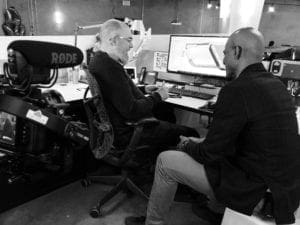
 

The biggest design challenge was to make it as thin and light as possible and yet without any compromise. Easier said than done. The design and engineering teams worked together and constructed dozens of prototypes,  undertaking extensive user testing as they refined it. With inspired engineering, the final design uses an aircraft-grade aluminum sliding frame with articulated joints and snap-haptics hinge technology—as used in quality eyeglasses—which created a minimal form factor. The resulting product is a thin, robust phone case that transforms from case to magnifier reader and back again almost effortlessly.


“RKS is the next level in Industrial Design skills and creativity—they took our patented idea and made it world-class. No stone was left unturned—from design to the application of Psycho-Aesthetics to manufacturing. Ravi is a master at taking entrepreneurs and inventors like myself to market. I am very appreciative of my whole team’s effort and for making NearSight a reality.”

— Dr. Elise Brisco, OD, FAAO, CCH, FCOVD

Holistic Optometrist CEO 

Founder of Nearsight


The second RKS innovation on California By Design this week is the Elevate Grill. This innovation started as the challenge of creating a portable grill that carries like a briefcase, with handles that fold down as legs. The concept was posed by RKS Founder, Ravi Sawhney, to Creative Director Lance Hussey, who loves a good challenge!

Starting with a sketch of the closed grill, it looked like a simple briefcase. But this case was far from brief!  Lance and Ravi worked together, overcoming obstacles as they went. They needed enough depth for the burners to work properly and be elevated sufficiently above the table surface or ground so nothing around it would burn, and it needed a way to catch the grease from grilling and retain it when folded. The list of challenges seemed never-ending. Lance working with RKS Design team on Elevate GrillDesigning an efficient grill, easy to set up, precise in its heat distribution, simple to operate and great looking were some of the biggest challenges. The team progressed from hand sketches to CAD models to fast fails to design models. Finally, they were testing functional prototypes, followed by production samples required for safety testing.
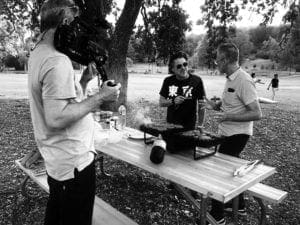
 

Lance Hussey points out that what makes the Elevate Grill first in its class is its ease of use, its efficiency and its portability. The Elevate Grill is unique, having ample surface area to cook for all of your family and friends, without the clumsiness and storage space requirements of a large grill. Every detail of this product has a purpose. It was designed with the canister, valve and propane tank stored inside the base, so parts do not have to carried separately.


The RKS team created the entire package: the product, the brand identity and the retail packaging that represents their vision for innovative products and forward-thinking culture.


Airs July 11th, 2020

KCBS Los Angeles-Saturdays at 3PM

KPIX Bay Area Saturdays at 7 PM

You have signed up for the designer!

Welcome to a world of design and innovation

Your download has started!

If this is not the case, then click the button below to start it