cAir
Service Design Venture
Redefining Air Travel for Families
RKS redesigns the flying experience to relax, entertain, and nurture family travelers
Inspired by Real Needs
Flying with kids is one of the single biggest stresses or fears of traveling parents. Imagine having a screaming baby strapped to a stroller with numerous bags hanging off the sides and running to catch a flight with everything and everyone in tow. Imagine being the recipient of the pitying and embarrassing stares from other travelers who all hope you are not on their flight. At some point or another, we are all guilty of having these unpleasant thoughts as we see families struggling with their loud, noisy children. It is a scenario that no one wants to see or even be in, but this is the reality for family travelers. Even experienced business and leisure travelers fear flying with their children and the potential embarrassment they may cause. Despite these pervasive fears and concerns, their special needs remain largely neglected in the air travel category.
RKS saw an opportunity to address these unmet needs of family travelers and launched project cAir as a derivative outcome from a workshop conducted by RKS at the Interaction Design Conference (IXDA ’10). Our goal was to conceptualize a service design venture that would inspire the air travel industry to change how services are delivered to traveling families. We assembled a team of designers, researchers, and strategists to tackle this challenge and employed RKS’ tools and expertise to rethink the flying experience.
How do you design the air travel experience for families?
It’s About the Journey, Not the Destination
RKS wanted to better understand the challenges and pressures facing family travelers and become immersed into their lives. By interviewing parents and shadowing passengers as well as researching blogs, articles, and social media sites, a holistic perspective of family travel was uncovered. The consumer’s journey was not isolated to the airport terminal and onboard experiences, but began with the very decision to have a family trip. It spans from pre-flight preparations, airport check-in, boarding, in-flight experiences, luggage retrieval to arrival at the ultimate destination. This process is cyclical as passengers take connecting flights and return home from their trip.
Leveraging this knowledge, personas were developed to promote contextual understanding and empathetic connection with the end-user. Psycho Aesthetics® maps were created to define opportunity zones for competitive differentiation from existing airlines. Relevant service touchpoints were identified taking into consideration all aspects of the user’s experience before, during, and after flying. The team determined the key attractors for designing and optimizing customer engagement strategies.
Architecting the In-Flight Service Experience
cAir is envisioned to provide an enjoyable flying experience for everyone by ensuring that the often neglected needs of parents and children are met. To this end, the team focused on the in-flight experience where family travelers spend a bulk of their time and delved deeper into the user’s frustrations and painpoints in this area. We identified six main categories of on-board flight experience touchpoints where families encountered the most challenges and service experience fell short.
• Entertainment – Children easily get bored without distractions or an outlet for them to spend their energy.
• Ambiance – Crying babies can be embarrassing and disturbing to both parents and other travelers. There is no privacy to calm children, ensure a sound naptime, or breastfeed an infant.
• Food – The food lacks nutritional information and allergen-free choices while appearing unfamiliar to kids. No convenient food storage options are available on hand.
• Seats – Standard seating and arrangement do not accommodate flexibility needed by children and families, making restless children more frustrated.
• Lavatory – Restrooms are too small to comfortably hold parent and child while changing tables are difficult to use, often forcing parents to leave the restroom doors open.
• Storage – Luggage space and accessibility throughout the flight is limited.
These insights and further brainstorming generated a service design blueprint outlining the key touchpoints, player involvement, enablers, ideal user benefits and service improvements. The team conceptualized and built service enhancements based on the six defined areas of on-board flight experience touchpoints. Each concept was fleshed out and storyboarded to capture comprehensive user perspectives and usage scenarios.
• Rent-A-Toy is a toy rental service concept focused on providing hassle-free entertainment to children during the flight. The toy is returned at the end of the trip or upon arrival.
• Sound Curtains allow instant privacy at the passenger’s seat, enabling parents to soothe or nurse a crying infant away from view.
• Nutrient cAir Service provides a variety of familiar, nutritious, allergen-free food choices for kids as well as USB bottle warmers and personal fridge within reach.
• Configurable Seats can adjust to accommodate children of all sizes while aisle partitions create a mini-play zone for toddlers and small kids.
• Diaper Friendly Lavatories are large enough to fit parent and multiple children for easy diaper change. A special sink is sized for a child’s height and a waiting area outside the restroom lets kids play till their turn.
• Layered Storage offers easy-to-reach storage compartments overhead and underneath the seat that is accessible throughout the flight.
RKS wanted to impart consistent and seamless experiences through cAir and thereby created a style guide to ensure prototypes and communications adhere to the brand identity and visual guidelines. Additional aspects of the cAir program were designed and manifested that address user touchpoints to provide a comprehensive experience.
• cAiravan is a fast, friendly shuttle service that provides child-safe seating, vehicle infotainment, easy stroller and luggage entry and storage, and transport to the destination.
• Quick and easy check-in kiosks for cAir passengers including a separate screen for children.
• cAir lounge with family waiting areas equipped to entertain children and larger restrooms to accommodate multiple family members.
• cAir signage that is recognizable by kids and adults.
• Boarding passes with clear information hierarchy.
• Single leaflet boarding passes with tear away souvenir of perforated plane.
• Digital product extensions beyond barcode scanning of the boarding pass from a smartphone. From the cAir app home screen, viewers can navigate to airport wayfinding, games, on-board amenities with related activities, and destination fun fact pages.
• Interactive screens at every passenger seat provide a personal experience for every traveler, young or old.
Together these strategies and manifestations create the total cAir experience culture focused on relaxing, entertaining, and nurturing. In summary, a family embarking on their first airplane trip benefits from these cAir experiences:
1. Quick and easy way to check-in for the cAir flight, including a separate screen for children.
2. Children can keep busy through security lines with the cAir game app.
3. Family waiting areas equipped to entertain children. These also include family restrooms.
4. Boarding card and wayfinding app help passengers get where they need to go.
5. Services for engaging and entertaining the children.
6. Making the cabin space personal and inviting, including keeping the noise levels down.
7. Parents can choose the types of meals that fit their family lifestyle.
8. Customizable seating for passenger preference as well as smaller safer seating size for children.
9. Restroom visits are easy and care-free because they provide family amenities such as diaper changing stations and varying sink heights, not to mention more room.
10. Storage that is easy to reach during flight and considers larger belongings that may be carried by parents with little ones.
11. Fast friendly shuttle service to their destination.
12. Fun and informative games to help supplement a great vacation.
13. cAir representatives who specialize in child care needs and family services.
Influencing Change
RKS was motivated by the real needs of parents traveling with their children who oftentimes feel marginalized by their air travel experience. Project cAir was designed to inspire the travel industry and bring attention to this commonly neglected group of travelers. Our vision is to create a pleasant and hassle-free air travel experience that would enable the “moment of truth” for consumers and generate viral demand and advocacy. Parents will no longer feel embarrassed by what their kids may do and or be treated as second class citizens.
Relax knowing that cAir will take care of your every need. You and your family will be entertained the entire trip. Take time to nurture your children just as you would at home…a flying experience that extends beyond just flying.
Catalyst
IDSA Awards Program
Good Design Equals good Business
RKS Helps IDSA Create a Meaningful Program, Platform and Brand
Design Disconnect
Purposeful design is an integral part of modern life, a driving force that improves our abilities to work, play, and survive. Design as a discipline is organic and evolves as our needs and aspirations grow and change. It helps companies produce meaningful products that connect with consumers; it builds confidence and value in goods and services; it thrives on change and innovation and is the fuel for sustained economic growth. Unfortunately, there has long been a disconnect between design and general awareness of its critical contribution to the success of products and services. It has been difficult to communicate in a clear, direct manner and too often, business leaders fail to recognize design’s strategic potential.
RKS founder and CEO, Ravi K. Sawhney, saw the benefit to the industrial design profession as a whole to create a platform upon which to communicate with relevance, interest and clarity, the real-world advantages to integrating design into the development and/or improvement of any product. Sawhney’s vision and leadership galvanized competitive design talents to a common goal—to develop a meaningful narrative that could be shared with industrial, corporate, and academic communities to make a compelling case for design.
Actual Case Studies
The program focused on actual case studies of commercially successful products, and the design’s contribution to that success. These are compelling stories of challenges, inspiration, processes and results, serving to inform, educate, and inspire others to consider the advantage to incorporating design into their development programs. It would be a catalyst for new opportunities. And thus, in 2002 the Catalyst® program was born.
How do you foster a profession’s strategic growth?
Good Design Equals Good Business
In conjunction with the Industrial Designers Society of America (IDSA), RKS made available a deeper and broader understanding of design’s powerful and positive impact to business, to people, and to the planet. The message—intended not only to business leaders but to the next generation of design professionals as well—is that good design fosters good business.
RKS Gives Back
RKS has worked with the IDSA on a pro bono basis to launch and guide the evolution of Catalyst®, developing the program’s strategy, structure and branding. Mr. Sawhney served as the initial Jury Chair of the case competition, assembling and collaborating with prominent design leaders in industry, education and the media. RKS led the development of web-based solutions that enable the jury to evaluate, provide feedback and collaboratively select the stories that help define the design profession to the world.
RKS then assembled a team of highly qualified professional writers that would bring honoree’s case studies to life. These writers interviewed the designers and executives behind each project, probing to understand the market dynamics, attitudes, processes and setbacks involved in each eventual design success story. To better serve business executives and students on the go, RKS then partnered with professional voice actors to record audio versions of each case available.
To be selected by a jury of your design peers for inclusion in the Catalyst® program is an honor indeed, and to further acknowledge the design excellence and corporate accomplishment of each winner, RKS designed and manufactured the coveted Catalyst® trophy. Machined from solid aluminum billet and mirror-polished, it shines as a beacon for the inspirational program and the brands it recognizes.
Making the Case for Design
The IDSA Catalyst® program now provides a library of cases for communicating design’s contribution to market performance and offers designers the tools, in the form of actual design case studies, with which to make the case for design’s strategic value. The series of in-depth cases explore how design has been leveraged successfully to generate revenue, or to positively address the social challenges of the day using intelligence, creativity and compassion. Included are great design examples from Toyota, Coca-Cola, Siemens, OXO, Apple, Oral-B, Kohler, Whirlpool, Black & Decker and others.
Today the Catalyst® program continues to accelerate change, bringing depth, clarity and transparency to the design process, while at the same time, illustrating the profession’s strategic, humanitarian and ecological impact. Download a case and learn more here.
DenMat (Discus Dental)
Oral Composite Dispenser
A Less Painful Dental Process
RKS collaborated once again with Discus Dental to create a user-centered solution to deliver ease-of-use, reduction of waste, and professional presentation.
Discus Dental is a leader in whitening, restoratives, oral hygiene and endodontics. RKS has been helping Discus achieve its business goals, since they were a start-up more than 15 years ago. The most recent collaboration between Discus and resulted in Nuance, a composite delivery system designed for use by dental professionals when performing tooth restorations or filling cavities. An improved extrusion syringe delivers a superior material that replaces amalgam, resulting in benefits to both the dental professional and the patient as well.
Great Stuff Deserves Great Delivery
Discus’ chemists engineered the Nuance composite material to furnish dentists with the physical and technical properties required for beautiful, long-lasting, and natural-looking results. While Discus had great new chemistry, past attempts had shown the benefits could become compromised by not fully designing the user experience and paying close attention to the needs and aspirations of patient, dental assistant and dentist simultaneously.
To develop user insights necessary to ensure a successful offering, the RKS design team first leveraged extensive research and ethnography analysis into the dental operatory itself. The team then mapped and benchmarked competitive offerings, brands and target consumer groups to identify pain points, and set the stage for innovating an improvement in the ease and efficiency of the experience.
How do you create a less painful procedure for dentists, dental assistants, and their patients?
The pain point analysis and “day-in-the-life” scenarios showed the dental operatory is a dynamic, cost-intensive and highly distractive multi-tasking environment. Interviews with dental assistants revealed they are typically asked to dispense composites while the dentist is working with a patient, and there are many distractions to doing this accurately. Caps get lost and expensive inventory gets ruined. As unused or wasted material represented a significant cost (the material costs roughly a third as much as 24K gold by weight), dentists desire the absolute minimal volume necessary for a given procedure. Control and accuracy in the delivery system was essential but not, however, available with the crank-and-screw delivery devices that dominated the market. While measuring the forces required to dispel the material, the design team found them to be difficult to use, especially with gloves on. Metering was inefficient; waste was inevitable.
A Smarter Syringe
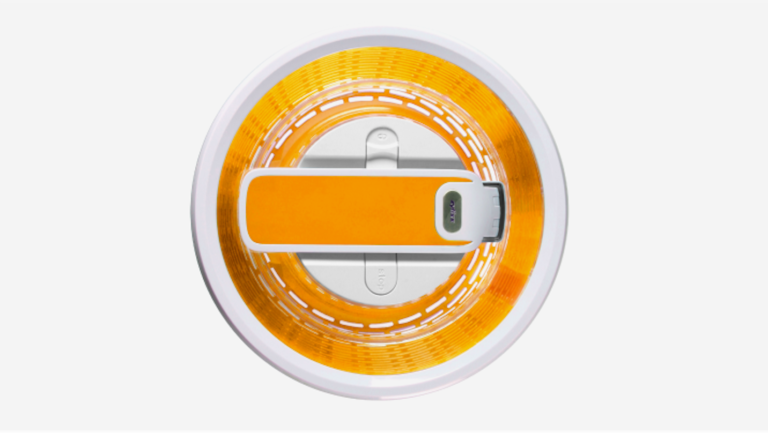
The whole delivery system was reconsidered. Control and precision metering were of paramount importance. Not only was it necessary to be able to accurately dispense exactly the amount of material required, but also to know at a glance how much material was remaining in the syringe. To this end, a calibration system was developed that dispenses a uniform “unit dose” of exactly 0.1 gram per half turn. Furthermore, to ensure that half turn is executed precisely, an audible and tactile click is produced as the user completes it. Guesswork is completely eliminated.
The plunger end was transformed into a calibrated indicator, an at-a-glance gauge of remaining material. Thread pitch and handle design were ergonomically engineered for maximum leverage and control as well as user comfort. The attached cap design prevents loss while better protecting the light-sensitive material. The overall architecture allows standing vertically and prevents rolling when laid on its side, as well as ample labeling surface for quick recognition of the specific material shade within.
Multi-tasking dental professionals can now count clicks as they accurately dispense NuanceTM—without even looking. The syringe provides easy, efficient operation, instant indication of remaining material, and enhances the operatory with a professional aesthetic. Despite the often-chaotic environment of the dental office, the new design ensures accuracy, economy, and prevents mistakes. NuanceTM has changed the game by holistically incorporating the needs and aspirations of all participants, and has been recognized with a Spark! and Silver Industrial Design Excellence Award in 2011.
Related Projects
Related Links
Awards
- Nuance – Red Dot (2012), GOOD (2011), IDEA-Silver (2011), Spark! Overall Competition Winner (2011)
- Zoom! – IDEA-Bronze (2003), ID Annual Design Distinctions (2002)
GizmoLive
Interactive Retail Pavilion Platform:
The Oracle of Consumer Technology
Designing an Experience to Educate, Entertain and Empower Technology Users
Profusion and Confusion
The consumer electronics industry grosses in excess of $200 billion a year in the U.S., with a seemingly unending profusion of technological advancements, evolution and choices. So vast is the onslaught of information and variety that even the most enthusiastic and engaged consumer is usually overwhelmed with confusion. The pace by which brands and models proliferate and are constantly updated and replaced by newer versions makes it nearly impossible for any manufacturer or retailer to adequately explain and demonstrate products features, and provide meaningful customer service. While it is essential for growth, competitiveness and profitability for these companies to develop new technologies and new offerings, it has created a serious gap in what is available and what can be communicated clearly and comprehensively to consumers. This consumer/technology gap could conceivable impinge on a significant percentage of that $2B in potential sales and revenue, and RKS saw the need to address the growing problem.
How do you create a service experience that overcomes the sea of confusion surrounding innovation?
Connecting the Dots
The sheer magnitude of this industry, with all its diversification, markets, categories, sources and consumer applications required a very in-depth investigation of the industry as a whole, the key consumer segments, and consumer expectations. RKS delved into the consumer mindset through its proprietary Psycho-Aesthetics® methodology, to learn and clearly understand how the consumer perceives, resonates and embraces technology and change. As clarity in the consumers’ needs and aspirations developed, RKS researchers discovered the connections between the products, the shopping/decision-making processes, and the experience itself of interacting with the products.
Studies were conducted on stores and malls, including traffic flow, regional and demographic trends, and keen observation of consumer behavior in a variety of scenarios and environments. It was essential to create an experience that would attract and resonate with the very consumers who sought to discover and understand the latest technological equipment, products and gadgets. The design team knew they had to educate, entertain, and empower these potential customers.
Magic in the Mall
The answer was an experience that embodied new technology itself, and was attractive, inspiring and easy to navigate. An interactive pavilion was the solution, offering a unique experience that would engage the consumer with an open architecture and a natural traffic flow, incorporating inviting seating, digital displays and intuitively accessed information. It shouldn’t be as complicated as the products it sought to simplify!
Gizmo Live was the result of this research and design process, bringing people and technology together in an environment that is inviting, exciting and almost irresistible to the tech consumer. Composed of modular elements, Gizmo Live is highly transformable, able to shape-shift to accommodate a variety of environments and a diverse selection of products.
Offering detailed product information, hands-on interactivity and personal one-on-one demonstrations by knowledgeable Gizmo Gurus, accurate information is quickly conveyed and confusion dispelled. Brand co-habitation creates a more realistic and real-life experience, and consumer confidence is raised.
Boosting the Bottom Line
The partner brands featured within the Gizmo Live pavilion have the opportunity to consumer-test and rotate products, switch out different promotions, and even generate on-the-spot retail sales with POS functionality. Reducing the mystery and confusion of the consumer electronics world will prevent the loss of an enormous amount of potential revenue, encouraging further development, innovation and economic growth for the country.